Stressed? Me too. Here are some tips that help me cut through the overwhelm. Well, some of it at least.
Before we get started, I want to make it clear that I am not a doctor, psychiatrist, therapist, or any other kind of professional that is authorized to give medical advice. What I am is a person with anxiety who sometimes struggles to do things because of it. These ideas will not fix everything or maybe even anything, but they have helped me and I hope they can help you too.
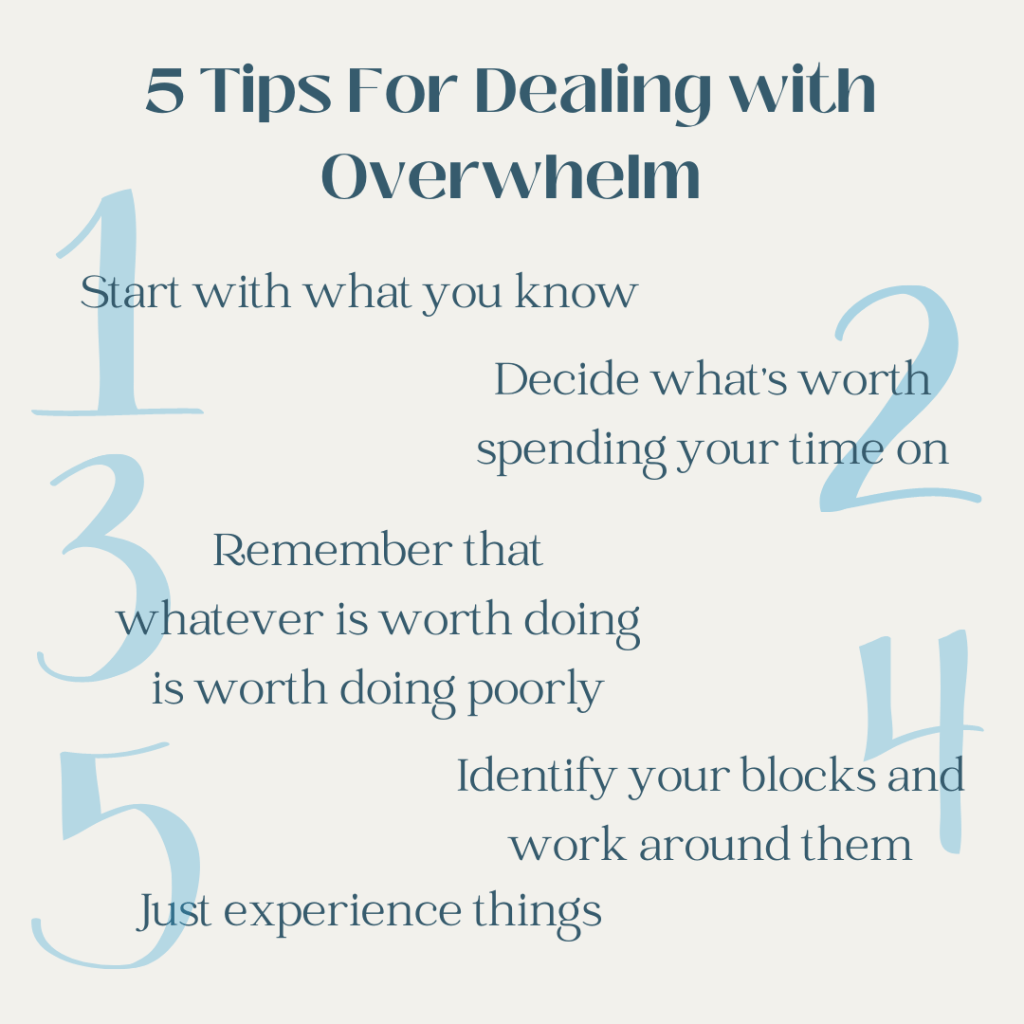
1. Start with what you know. Ideas will come.
A journey begins with a single step and the only way to eat an elephant is one bite at a time. I do not recommend eating elephants, as they are endangered and not an acceptable food choice. However, the idea is that you don’t have to do it all at once. You don’t even have to have it all figured out at once. Just get started, do the part you know, and ideas will come with time. All you have to do right now is start.
2. Decide what’s worth spending your time on.
Ask yourself: what energy do you have? Recently I’ve been watching YouTube videos about decluttering and keeping up with messes in the home. One popular tip is to “do it for future me.” The idea is that you’re never (or rarely) going to feel like doing some tasks, so you should do it now so future you doesn’t have to. This mindset can work in some instances, but it ignores the fact that sometimes it’s current me that needs the help, and that’s ok. Rather than force myself to do a task—let’s say wash the dishes—I evaluate where my energy is. If I am tired and overwhelmed, my evening would be better spent unwinding and preparing mentally for the next day than spending that time washing dishes. Dishes are not life or death, so I give myself permission to not.
You can’t do everything, and that’s ok. Listen to your body and mind and use your limited energy on what you actually need, not what you think you’re supposed to do.
3. Remember that whatever is worth doing is worth doing poorly.
Or, something is better than nothing. When there is too much to do, remember that a small effort is better than no effort and will help you progress. If you have a homework assignment and it feels impossible, answering a few questions and turning it in will be better than nothing. A 50% is much better than a 0%. Similarly, washing a few dishes (even if it’s just a few plates) is better than no dishes, and will help you be less behind. You may even find that starting a project gives you the motivation to finish it—but if not, that’s fine too. You did your best.
Don’t let perfectionism stop you from doing little bits here and there as your energy and time allow.
4. Identify your blocks and work around them.
There’s an excellent Ted talk called “How to do laundry when you’re depressed” by KC Davis that everyone should watch because she has so many good points, especially for those struggling with mental health. For example: cleanliness is morally neutral. A stack of dirty dishes is not morally wrong, and a stack of clean dishes is not morally right.
In the Ted talk, Davis shares that during the pandemic her house became out of control for a variety of reasons, including having a baby and not having the support system she had planned for because of the pandemic. She was burned out and overwhelmed and stuck. One of the things that was out of control was laundry, and piles of laundry were everywhere. Davis finally realized that the hardest part of doing laundry for her was folding the laundry and putting it away. She also realized that she didn’t care about wrinkles on most of the clothes she was spending so much time folding. Her solution? Stop folding clothes. As soon as clothes came out of the dryer, she sorted them into cubbies for each family member and was done.
Maybe there’s a step you can remove from your routine. Or if you can’t remove it, maybe you can adapt it. For example, I don’t like putting away dishes, and for some reason having to put away dishes makes the entire task of washing dishes way more difficult than it should be. I have three ways of dealing with this. One, I give myself permission to put wet dishes on top of dry dishes in the dish rack. Two, I make a habit of using dishes directly from the dish rack and dish washer, as well as using time spent in the kitchen waiting for the microwave to finish to put away some dishes. That way, when it’s time to do dishes, there are fewer waiting there for me. And three, I make my husband put away the dishes so I don’t have to. The option I choose depends on my needs at the time.
Spend some time thinking about what tasks are hard for you and think of ways around them. Do what works for you, because everyone deserves a functional space.
5. Just experience things.
It’s ok to just experience things. Not everything you do has to have a greater purpose. You do not always have to be working towards some greater goal. It is good to sit outside and do nothing but feel fresh air on your face, even though that doesn’t get your homework done. It is good to read a book, just for fun, even though that isn’t making you money or cleaning your house. These things are for you and your wellbeing, and that is important.
And if your experiences aren’t positive, that’s ok. You don’t have to try to understand your feelings or why things are the way they are. If you feel sad, let yourself feel that. Feeling bad does not mean you are bad.
A quote from Lucy Grealy describes this idea beautifully. As a child, Grealy had cancer in her jaw. The treatment was successful, but it destroyed her jaw and disfigured her face. She spent many years going through surgery after surgery to correct it, yet nothing worked completely. This quote is taken from a scene in her essay “Mirrorings” where she has just found out she must have yet another painful surgery.
“I could not imagine going through it again, and just as I had done all my life, I searched and searched through my intellect for a way to make it okay, make it bearable, for a way to do it. I lay awake all night on that train, feeling the tracks slip beneath me with an odd eroticism , when I remembered an afternoon from my three months in the hospital. Boredom was a big problem those long afternoons, the days marked by meals and television programs. Waiting for the afternoon tea to come, wondering desperately how I could make time pass, it had suddenly occurred to me that I didn’t have to make time pass, that it would do it of its own accord, that I simply had to relax and take no action. Lying on the train, remembering that, I realized I had no obligation to improve my situation, that I didn’t have to explain or understand it, that I could just simply let it happen. By the time the train pulled into King’s Cross station, I felt able to bear it yet again, not entirely sure what other choice I had.”
Lucy Grealy, “Mirrorings”
All she had to do was exist, and allowing herself exist let her move forward.
Let yourself exist just to exist, whether you are in a positive or negative space. Don’t pressure yourself to do or be something other than what you are doing or being.
That brings us to the end of these tips. I hope they’re helpful to you, and I’d love to hear any additional tips that have worked well for you!

 Almost Canadian
Leave a comment